![ALLFIE [logo]](https://www.allfie.org.uk/wp-content/themes/allfie-2025/assets/img/allfie-logo-original.svg)
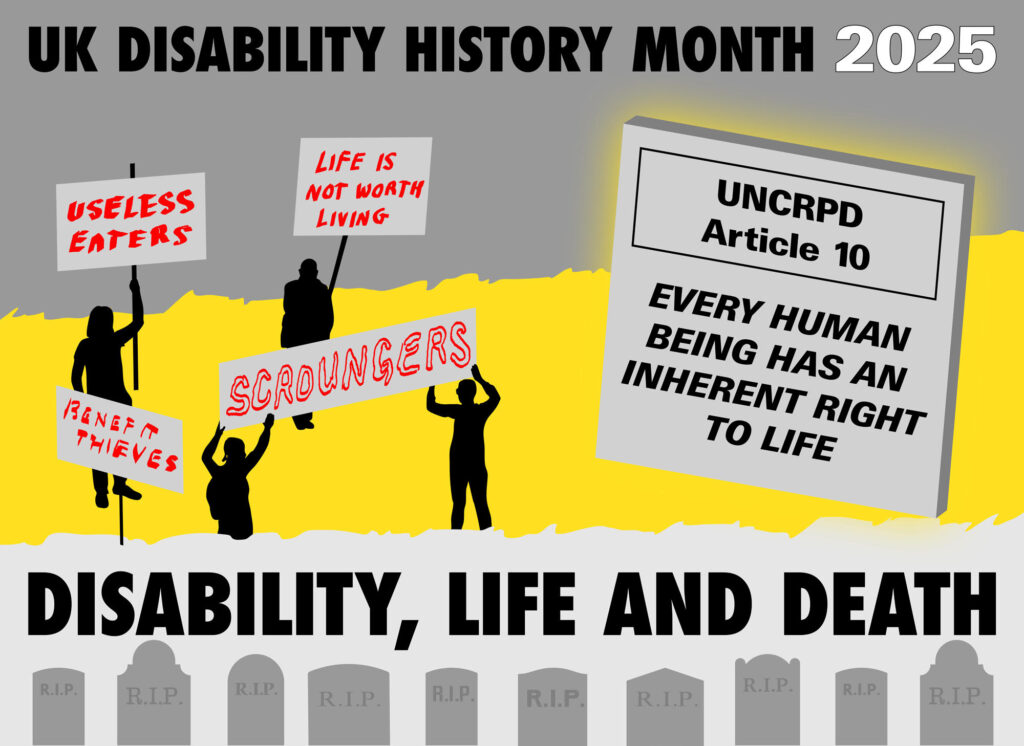
UK Disability History Month 2025: Disability, Life and Death
By Richard Rieser, UK Disability Month Coordinator

UK Disability History Month in the Autumn of 2025 has the theme Disability, Life and Death. With over 300 UK Disabled People’s Organisations opposing the current draft legislation on Assisted Death, this year is a good time to look through a historical lens and consider why Disabled people have learned to be suspicious of giving the State the power of life and death.
We have faced sterilisation, isolation, euthanasia, and death as a result of social prejudices backed by the false science of eugenics that emerged in the late 19th century and the first half of the 20th century. Prior to this, our lives as Disabled people were also precarious; at any point we could become the target of ignorance, religion, myth and superstition, all of which projected fears and anxieties onto us as scapegoats.
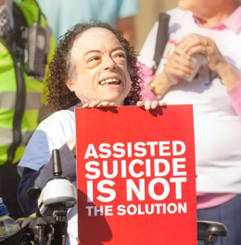
The main points raised by the campaign Not Dead Yet UK are:
1. Evidence of ‘legislation creep’ in countries where assisted death is legal suggests a similar risk if the law is changed here.
2. The restrictions society places on Disabled people denies them true choice and control.
3. In the absence of choice and control, the role of physicians in assisting a Disabled person to take their life undermines the principle of informed consent.
4. Assisted suicide legislation conveys the message that living with an impairment or a long-term medical condition is a fate worse than death.
5. The government’s role should be to increase resources for palliative care, improve support for Disabled people, and uphold its commitment to enabling their full participation in society.
The campaign for Assisted Death has been pushed by some key individuals and the media. But a representative survey in June 2025 found 67% agreed the UK Parliament should prioritise improving access to care over introducing assisted dying. Only 13% disagreed. Six in ten agree Disabled people risk being coerced into making a decision. The fact that this survey was carried out just after the Labour Government’s backdown on cuts to Disabled people’s welfare demonstrates that, currently, a majority support Disabled people and their human rights. But it was not always like this. That is why we need to insert Article 10 of the UN Convention on the Rights of Persons with Disabilities:
“States Parties reaffirm that every human being has the inherent right to life and shall take all necessary measures to ensure its effective enjoyment by persons with disabilities on an equal basis with others.”
Eugenics is the ideology that human populations should be “improved” through social policies, such as selective breeding – encouraging people with “desirable” traits to have children while discouraging those with “undesirable” traits. It’s a coercive ideology. It involves people in positions of power making value judgements about which traits are desirable or not, and so who is deserving of reproduction or not, and it inevitably leads to human rights abuses”. Developed by Francis Galton, Darwin’s cousin, eugenics sought to apply Darwin’s ideas of evolution to living human beings. It focused on eliminating conditions including schizophrenia and epilepsy. The amorphous feeble minded was the focus, along with the so called weaker ‘races’. This ideology was an echo back to classical Greek discourse in Plato’s Republic. Spartans were known for exposing on mountainsides their babies to eradicate the weak (and Disabled people). Many of those who established Eugenics as a study were drawn to it because of their Classical education which was popular across Europe at the time.
Previously in the workhouse and in asylums, conditions for Disabled inmates were very harsh. This led to high death rates.
In the United States of America (USA), sterilisation of Disabled people who were thought to have hereditary conditions began in 1907 and continued in 37 states up until 1950s. In the UK, the Movement for Eugenics was just as strong but, despite Winston Churchill as Home secretary supporting legislation to introduce it, it was defeated. Instead, the Mental Deficiency Act was introduced in 1913 leading to many people with learning difficulty being incarcerated for life in colonies and long stay hospitals until they closed towards the end of the century. Intelligence Quotient (IQ) was often used to segregate people even though we know this to be culturally, racially and disability biased. The Open University provides an education pack with lots of class-based activities on this history.
In Germany, Hitler copied these ideas and took them further to eliminate all those who were deemed to be unworthy of life – Disabled people, Jews, Gypsies, Roma, homosexuals, people from the global majority, and communists. Numbers vary but the German Government has acknowledged 275,000 were murdered by the regime. Interestingly, Edwin Black in War Against the Weak estimates that more than one million Disabled people across the whole occupied German Empire were murdered. Hundreds of doctors carried out the killing of adults and children but only nine were executed at Nuremberg.
Looking back before the Holocaust, it is hard to understand how popular and widespread the idea was of eliminating the ‘Useless Eaters’ – todays Burden or Benefit Street.
DH Lawrence stated:
“If I had my way, I would build a lethal chamber as big as the Crystal Palace, with a military band playing softly, and a Cinematograph working brightly; then I’d go out in the back streets and main streets and bring them in, all the sick, the halt, and the maimed; I would lead them gently, and they would smile me a weary thanks; and the band would softly bubble out the ‘Hallelujah Chorus’.”
Winston Churchill, writing to Asquith Prime Minister in 1910, declared:
“The unnatural and increasingly rapid growth of the Feeble-Minded and Insane classes, coupled as it is with a steady restriction among all the thrifty, energetic and superior stocks, constitutes a national and race danger which is impossible to exaggerate… I feel that the source from which the stream of madness is fed should be cut off and sealed up before another year has passed”
HG Wells could not contain his enthusiasm, ‘hailing eugenics as the first step toward the removal “of detrimental types and characteristics” and the “fostering of desirable types” in their place’.
George Bernard Shaw wrote:
“The only fundamental and possible socialism is the socialisation of the selective breeding of man”. Later he mused that “the overthrow of the aristocrat has created the necessity for the Superman”.
Looking back, but also forward to inaccurate and populist ideas we can see today, these views all present danger.
The answer is a form of full Inclusive Education, where children go to school together regardless of their need or impairment, and the school, its staff and curriculum are adapted to remove all barriers with children growing up respecting diversity and difference. The alternative is the rekindling of prejudice and hatred drawing on the oldest superstition; our fear of strangers, and physical and mental difference, because they frighten us!
Disability History Month runs from the 20th November to the 20th of December 2025.