![ALLFIE [logo]](https://www.allfie.org.uk/wp-content/themes/allfie-2025/assets/img/allfie-logo-original.svg)
Developing Inclusive Education in the Caribbean
October 2025 witnessed a focus on Disability Rights and developing Inclusive Education in the Caribbean. Richard Rieser reports back.
Firstly, the Commonwealth Parliamentary Association (CPA) which has a policy focus on Disability Rights and Inclusion, held its Annual Conference in Barbados. The CPA had delegates from 187 Parliaments across the Commonwealth (these comprise national and provincial or state Parliaments as well as British Overseas Territories and Crown Dependencies). The CPA has a Commonwealth Parliamentarians Network of Disabled people and is also supporting the Commonwealth Disabled People’s Forum effort to get a Disability Inclusion Action Plan (DIAP) adopted next November in Antiqua at the Commonwealth Heads of Government. The CPA held a Town Hall meeting with their members and around 60 Disabled activists from Barbados with Kerryann Ifill, CDPF Vice Chair. Richard Rieser, as General Secretary, also addressed a meeting looking forward to CHOGM 2026 and the DIAP.
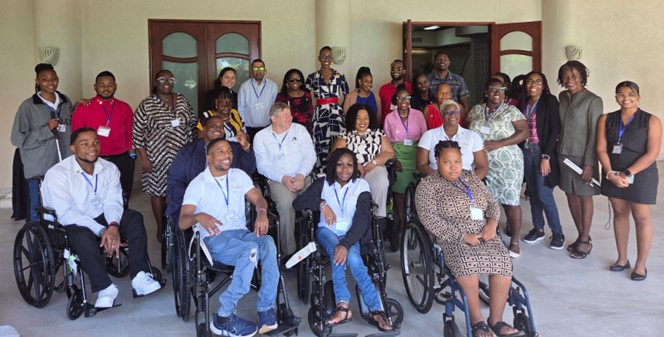
Secondly, the CDPF held a regional training in Barbados to develop Young Disabled Leaders in the Caribbean. Held in Barbados from 14th to 16th October 2025, it brought together Young Disabled leaders from across the region (20 from 11 islands: Bahamas, Dominica, Granada, Guyana, Jamaica, St Kitts and Nevis, St Lucia, St. Vincent and Grenadines, Trinidad and Tobago, Barbados, and Belize remotely). This comprised 11 women and 10 men aged between 18 and 35, with a wide range of impairments. Hosted by the Commonwealth Disabled People’s Forum (CDPF) with Disability Equality trainers from Guyana, Barbados, Bahamas and the UK, it was designed to strengthen the leadership skills, confidence, and advocacy capacity of Disabled youth through the lens of the Social Model of Disability and Disability Inclusion. Using participatory and experiential learning approaches, trainees explored issues of language, models of disability, Inclusive Education, barriers to equality, human rights under the United Nations Convention on the Rights of Persons with Disabilities (UNCRPD) and developed a personal and country action plan.
Participants highly rated the training, and here are some of their comments:
“There was so much information and knowledge that I gained from this training that I did not know. It has made me more educated and empowered” (Participant feedback)
“I believe that this training and forum greatly prepared me to go to my country and fight and stand-up for disability rights.” (Participant feedback)
“I am taking away a new level of self-confidence and a better understanding of disabilities, including my own.” (Participant feedback)
“Words cannot explain the amount of knowledge I am taking. But it is definitely helping me to be a better and more effective advocate.” (Participant feedback)
Outcome Activity 3, Barriers and Solutions for Inclusive Mainstream Schools: This activity focused on identifying barriers to inclusion in mainstream education and developing practical solutions. Discussions were organised under four categories of barriers: environment, organisation and curriculum, attitudes and culture, medical and equipment needs.
- Environmental Barriers: Poor infrastructure, stairs without ramps, inaccessible classrooms, inadequate space, and lack of transportation options.
Solutions: Retrofit schools with ramps and accessible bathrooms, adopt universal design, and consult with Disabled people in all infrastructure planning.
- Organisational and Curriculum Barriers: Untrained teachers, inflexible curriculum, lack of Inclusive Education policies.
Solutions: Mandatory inclusive teacher education, early introduction of inclusion principles, and adaptive teaching strategies.
- Attitudes and Cultural Barriers: Bullying, stigma, religious prejudice, overprotection, and low expectations.
Solutions: Sensitisation training for teachers and students, positive media representation, and open dialogue to normalise inclusion.
- Medical and Equipment Barriers: Limited access to assistive devices, interpreters, or trained support staff.
Solutions: Greater investment in assistive technology, reduced import taxes on mobility aids, and inclusive healthcare and school support systems.
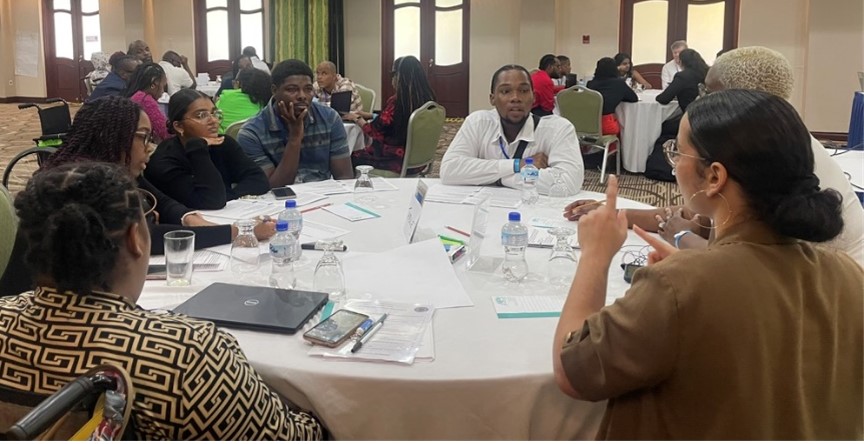
The following week CDPF collaborated with the Caribbean Disability Network on a four-day conference on developing Inclusive Education in the Caribbean. The verdict was that starts have been made in most islands but provision is mixed, still relying on special schools. However, increasing numbers of schools and teachers are prepared to include Disabled students. Much more must be done.