![ALLFIE [logo]](https://www.allfie.org.uk/wp-content/themes/allfie-2025/assets/img/allfie-logo-original.svg)
Tammy Harrison: Day in the life at school
By Michelle Daley and Melody Powell
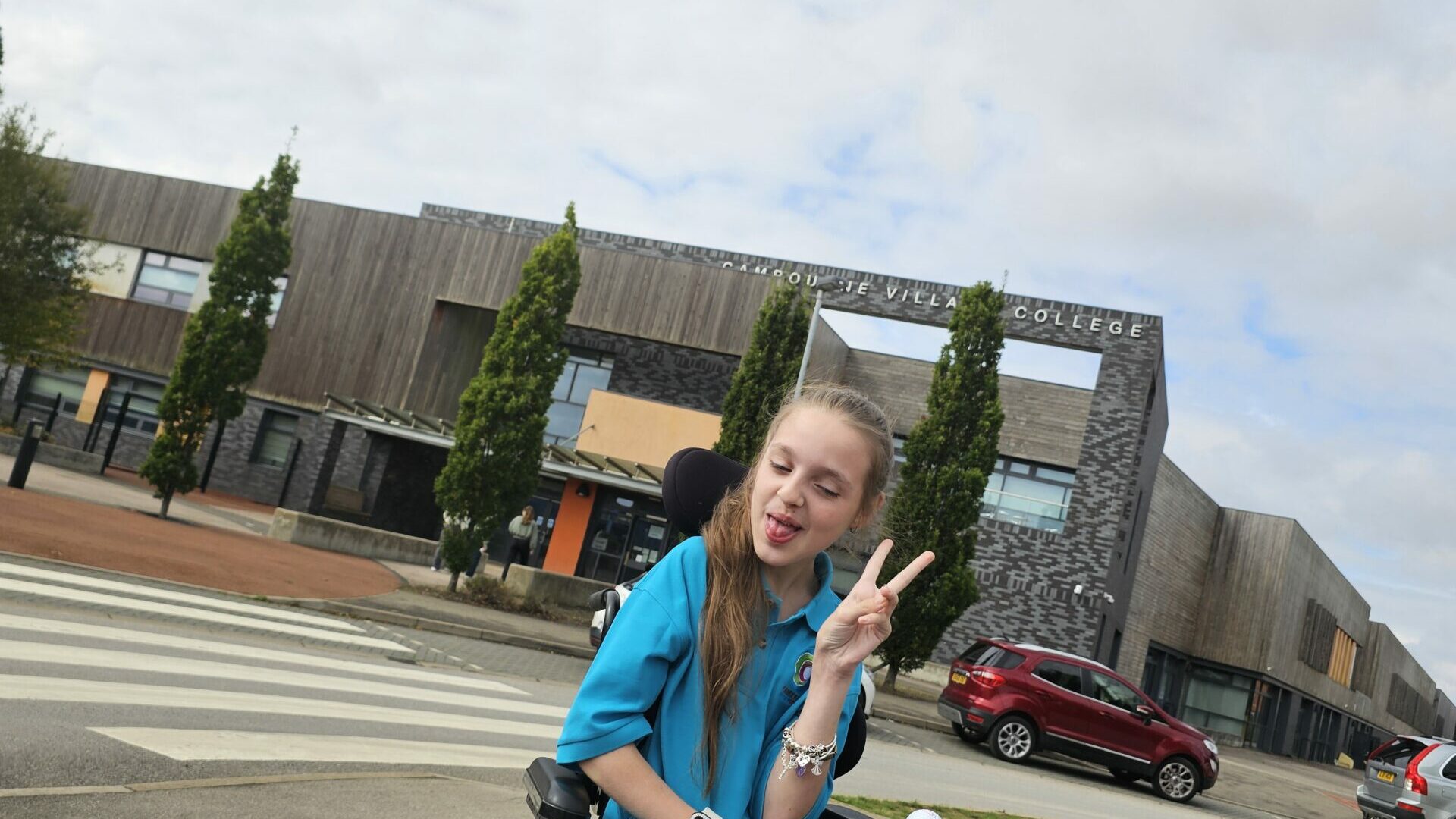
We had the great pleasure of interviewing 12-year-old Tammy Harrison, who featured in the Channel 4 Equal play documentary, televised in August 2024 as part of the Paralympics coverage. We were keen to catch up with Tammy to hear about what a typical school day looks like for her, and how Inclusive Education in mainstream schools makes a difference.
We started the interview by asking Tammy to tell us about herself. She’s the Youngest of three siblings, has two dogs and loves baking banana cake (something she has clearly perfected), but is not planning a career in baking. Tammy enjoys sport, particularly wheelchair track racing, and her favourite hobby is anything creative, especially art.
Her morning starts at 7:15am, usually checking TikTok or catching up on EastEnders. Then she has breakfast and heads to school.
To help inform our write-up of the interview we’ve aligned it with ALLFIE’s seven principles for Inclusive Education.
Diversity enriches and strengthens all communities
We met with Tammy via Zoom on 21st May and it was clear Tammy enjoyed sharing her experiences at her local mainstream secondary school.
As highlighted in Equal Play, this journey hasn’t come without barriers. She was denied access to certain subjects in her primary school and had to fight to attend her current secondary school. Tammy remains a committed advocate for Inclusive Education in mainstream schools.
For Tammy, it’s important that Disabled children go to the same schools as everybody else. She said, “Yeah. In my eyes, they’re not seen different in a wheelchair, but the wheelchair just makes them, them basically.”
She told us that she was excited to share her schooling experience to help other children and families feel more confident:
“Because I feel that a lot of the families are a bit worried about sharing their story, so I’m sharing mine, so they don’t feel as worried to share theirs.”
Support is guaranteed and fully resourced across the whole learning experience
We talked in detail about the adjustments and support Tammy receives in school. She has a dedicated Teaching Assistant (TA), who she clearly gets on with:
“Most of the time, I hang around at break or lunch with friends and whenever I have my break, she’s having her break so she won’t be in the room, but two other adults will be in the room in case anybody needs them, but they don’t say anything”.
Tammy also shared that the school has four lifts:
“Yeah, there’s one in the library, one in the science block and one in orange, and one by the office.”
She also mentioned the adjustable tables: “The tables can go up and down,” and noted that the schools has two changing place facilities: “It has a bed, a hoist, a toilet that flushes by itself.”
Tammy finds power in knowing she’s not alone, there are other Disabled pupils at her school. She told us “One of the students, she’s Deaf and the teachers wear this thing and it’s like a microphone and they connect it to her hearing aid, and they speak though it so she can hear what they’re saying.”
“There’s two others [Disabled pupils]. One can walk with a walker, and one can’t walk at all.”
She describes the accessible transport the school provides:
“They’ve actually got this van… Yeah, they’ve got three spaces like that [wheelchair accessible spaces]. I went on a sports trip to Cumberland to see how sports were for Disabled people [there]. My school is full of activities like bowling [boccia]; they got this ramp and put it on my lap… they have like it’s a simple hit the ball at the target game.”
All learners are enabled to fulfil their potential by taking into account individual requirements and needs
When we asked whether Tammy attends lessons with her form group or in separate classes, she explained:
“So, there’s this thing called groups and I’m in 7R… But yeah, I do do it with other people.”
It was clear Tammy doesn’t feel segregated at school. Unsurprisingly, given her love of creative activities, her favourite subject is Design and Technology (DT):
“Yes, I have an adult to help me, but on the bits I can do she leaves me and lets me get on with it so if I need help I say can you help me?’ and she will help me”.
All learners’ different learning styles and achievements are equally valued, respected and celebrated by society
Tammy also spoke proudly about a recent collaborative creative project in class, highlighting how her contributions are valued:
“So what we’ve been doing is drawing it and then we are gonna cut the drawing out and it folds and we will put it in like a fish shape.”
Her enthusiasm showed how much she enjoys being part of mainstream learning experiences, and how her achievements are recognised, celebrated and valued like all other pupils in the school.
We asked Tammy about other aspects of school she enjoys, as a way to understand how she feels valued, respected, and celebrated. She smiled: “home time!” She laughed, adding, “Oh yeah, the teachers” too.
One teacher was her favourite: “Miss Nash. I go and see her in the morning. We chat about how our morning’s been, and we chat… and if I have a lesson with her that’s my favourite lesson of the day.”
We asked what subject Miss Nash teaches. Tammy responded, “when my class is doing Spanish, I do extra English or extra Maths with two other boys.”
All learners need friendship and support from people of their own age

When we asked Tammy how she usually spends her lunch break, she beamed. It was obvious she’s well-known and well-liked.
“Hang out with my friends. Sometimes… my boyfriend comes to see me.”
We asked what makes her friends awesome. Tammy replied:
“Um they just see me as Tammy… they’re not bothered by my wheelchair they’re just bothered by the person.”
She added, “I think because most of them [friends] went to primary school with me they are used to seeing the wheelchair.” She explained that her wheelchair helps her get around. But since starting secondary school she’s gone on to make new friends.
Tammy also pointed out that her school encourages all pupils to make friends with each other.
All children and Young people are educated together as equals in their local communities
Since Tammy had mentioned her favourite part of school was home time, we were curious to know what she gets up to after a school day.
“[I] go upstairs, watch my TV and relax,” she said. She also keeps in touch with friends via FaceTime and likes to visit the local park where she uses her racing wheelchair and meets up with school friends.
Inclusive Education is incompatible with segregated provision both within and outside mainstream education
We ended the conversation by asking Tammy what message she’d like to share with Inclusion Now readers about why Inclusive Education in mainstream schools is a human rights matter.
Reflecting on her own experience of being excluded from lessons and having to fight to attend her current mainstream school. Tammy urged others to speak up:
“Because what I think is… they used to leave me out, never let me join in with anything. But if you speak up, they will let you join in. So just don’t be scared.”
She reinforced the importance of speaking up as an action for change:
“Yeah, I feel that you shouldn’t be left out at all. But if they do – speak up. Nothing will get done if you stay quiet.”
Tammy concluded Inclusive Education should not be a struggle:
She doesn’t think that Disabled children should have to fight to be able to attend mainstream schools.
“I don’t think it should have to be spoke about. I just think it should just be normal…do it a bit differently so that Disabled children can be included.”
And finally, she added: “It shows that they’ve got a story.”